Why be a Bayesian
A non-technical introduction to the Bayesian approach
Daniel Skak Mazhari-Jensen
2026-10-08
What is this Bayesian thing anyway?
Chat with your neighbor for 3 minutes:
- Have you heard about Bayesian models/inference/approach?
- If yes, in which context?
- What do you think it means (no guarantee it’s the “right” answer, but give it a try!)
How many have heard about Bayesian inference? 🙋♀️🙋
How many already use a Bayesian workflow? 🙋♀️🙋
How many have read a paper using Bayesian stats? 🙋♀️🙋
How many (of you) understood that paper using Bayesian stats? 🙋♀️🙋
Are you ready to get a non-technical introduction? 🎉🥳
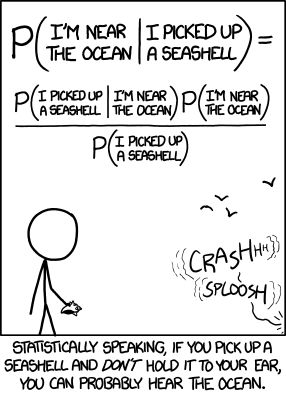
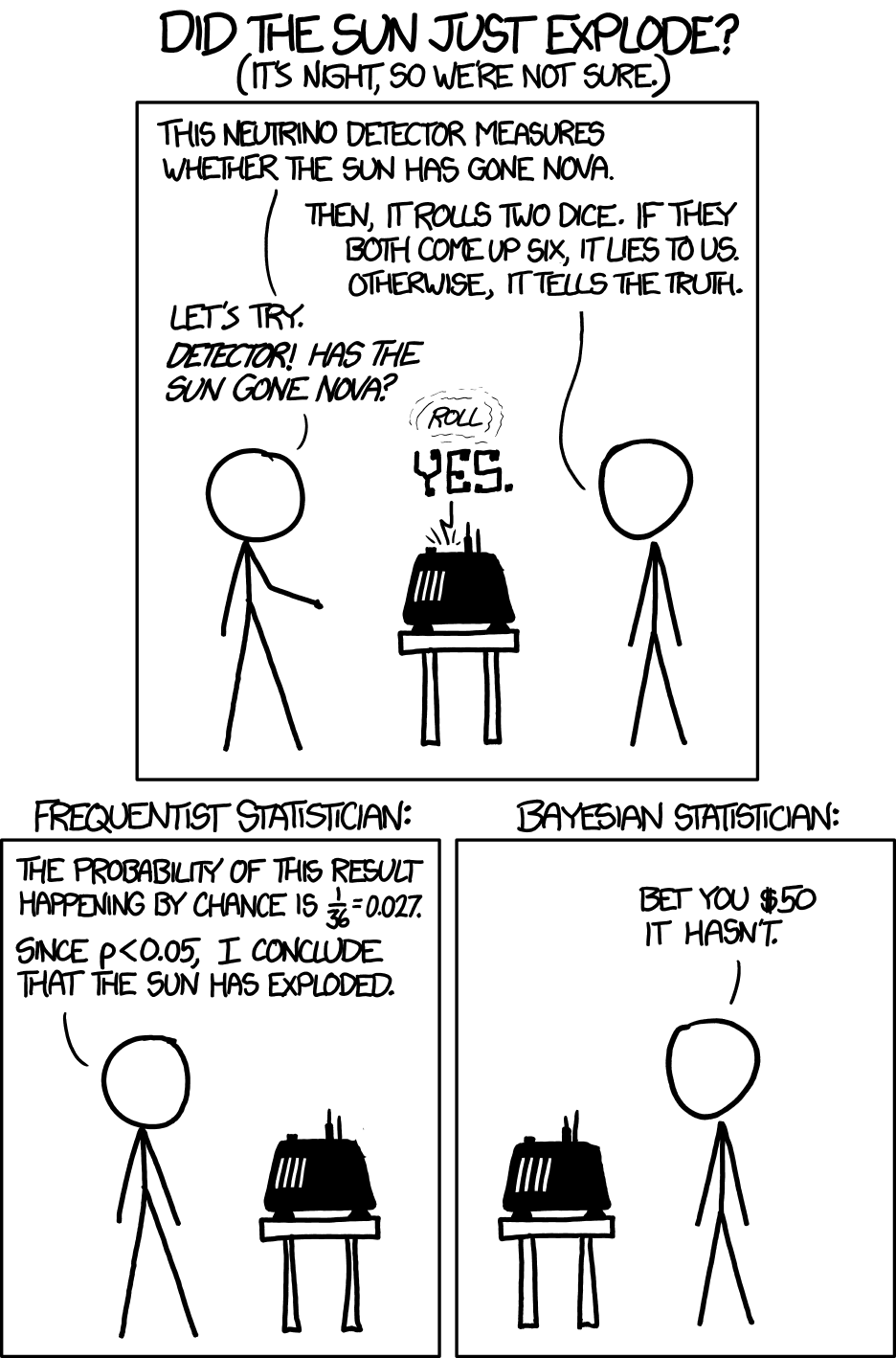
Bayes in the style of xkcd
![]()
But why is this different from other stats?
But why is this different from other stats?
![]()
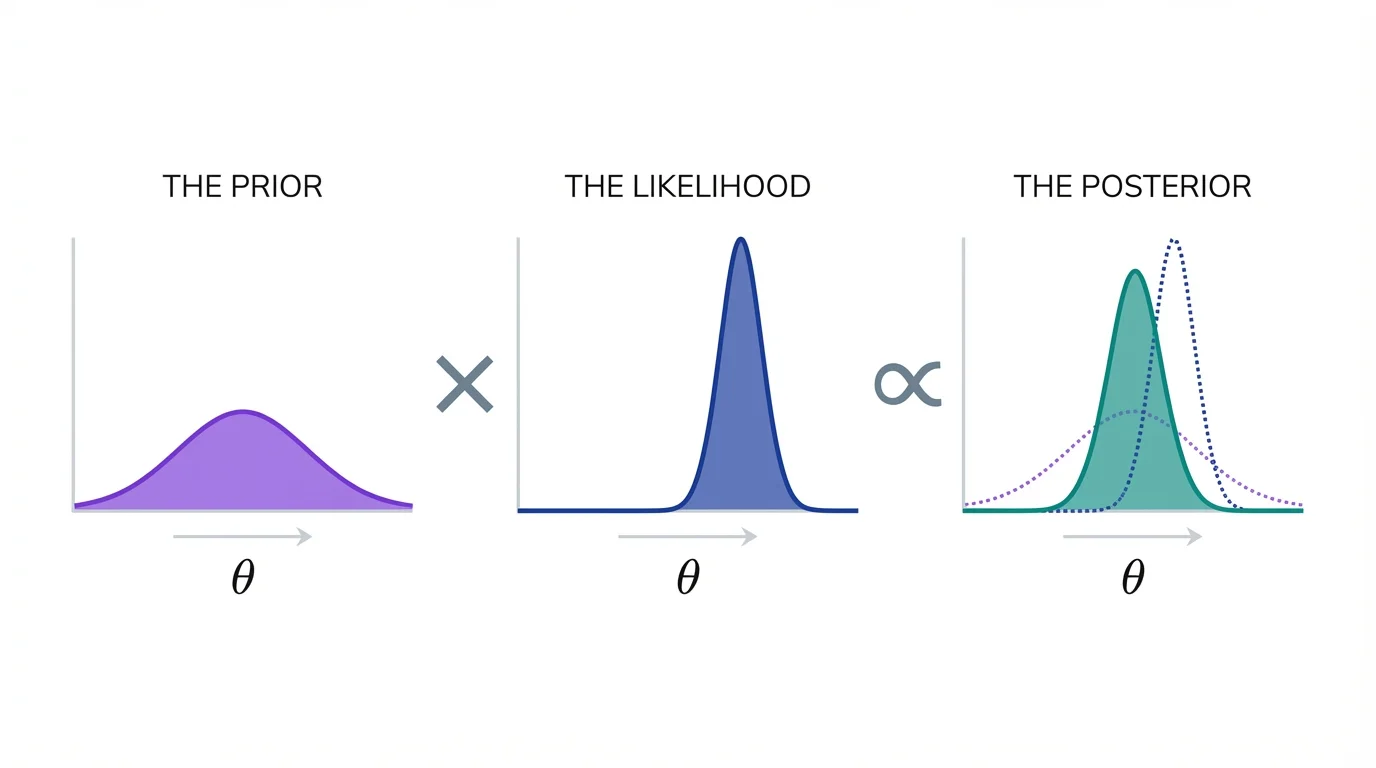
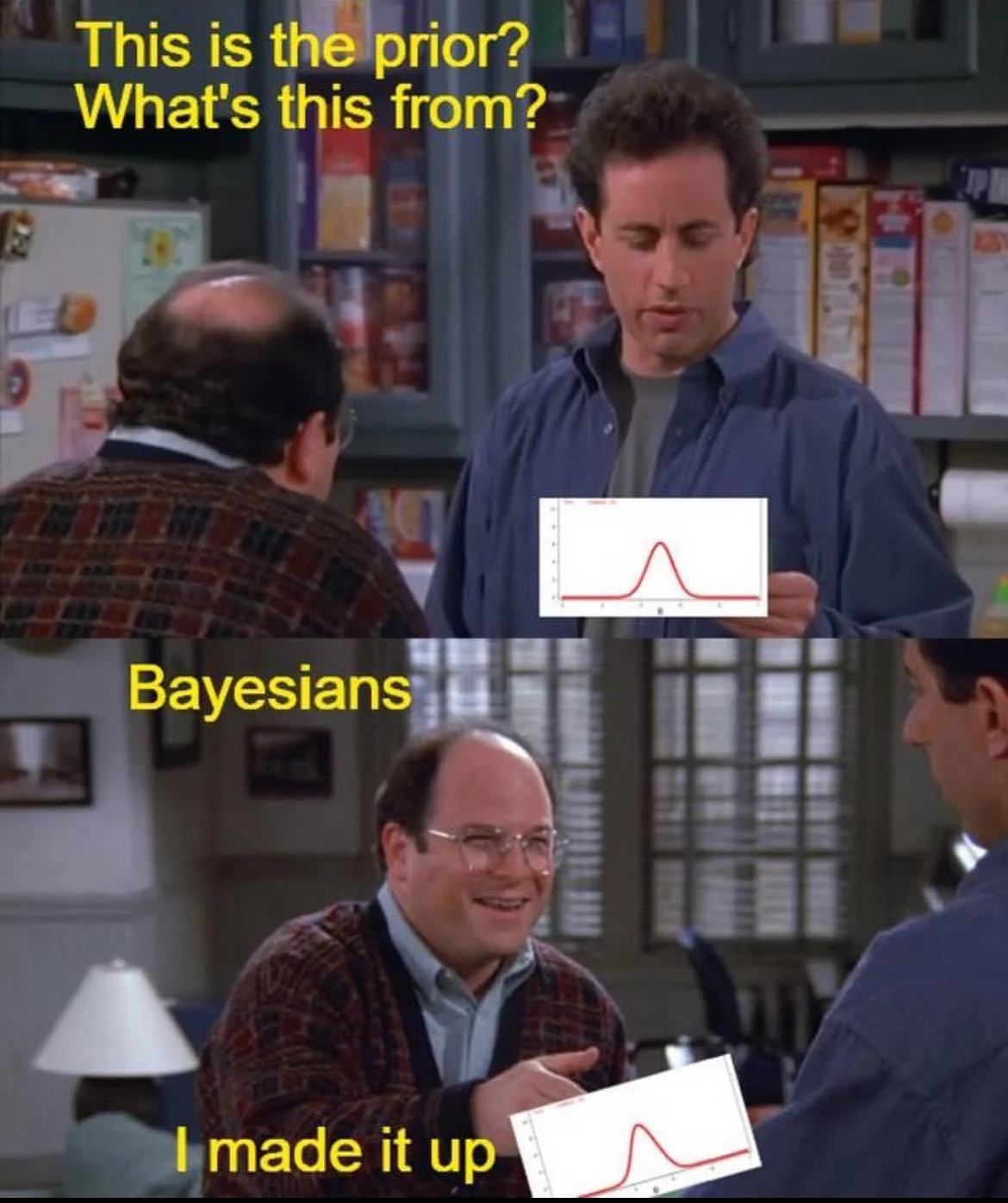
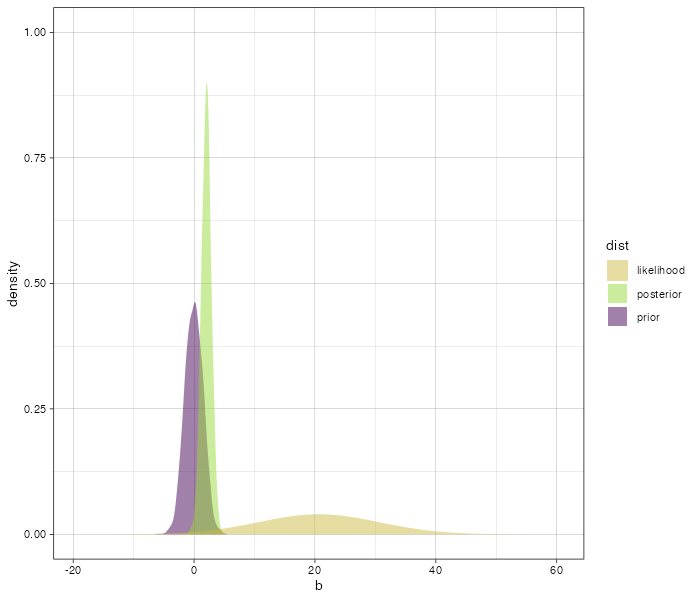
Bayesian prior
![]()
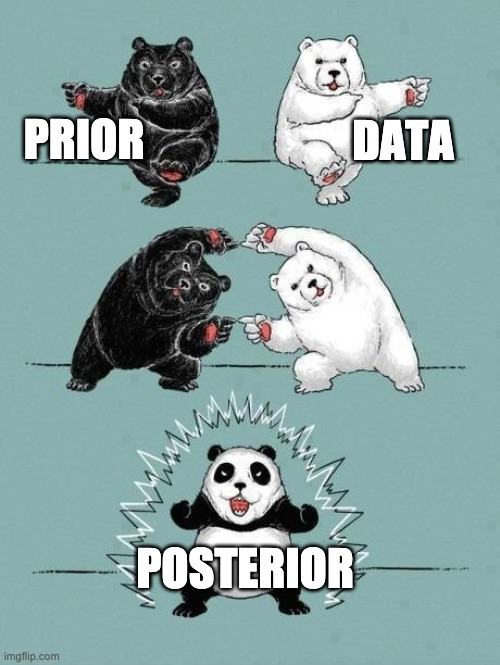
How priors are made (up)
![]()
The fear of the prior
frequentists are often suspicious of priors because a prior can look like smuggling assumptions into the analysis before seeing the data.
Their instinct is:
Let the data speak for itself
or
The prior biases the model a priori!
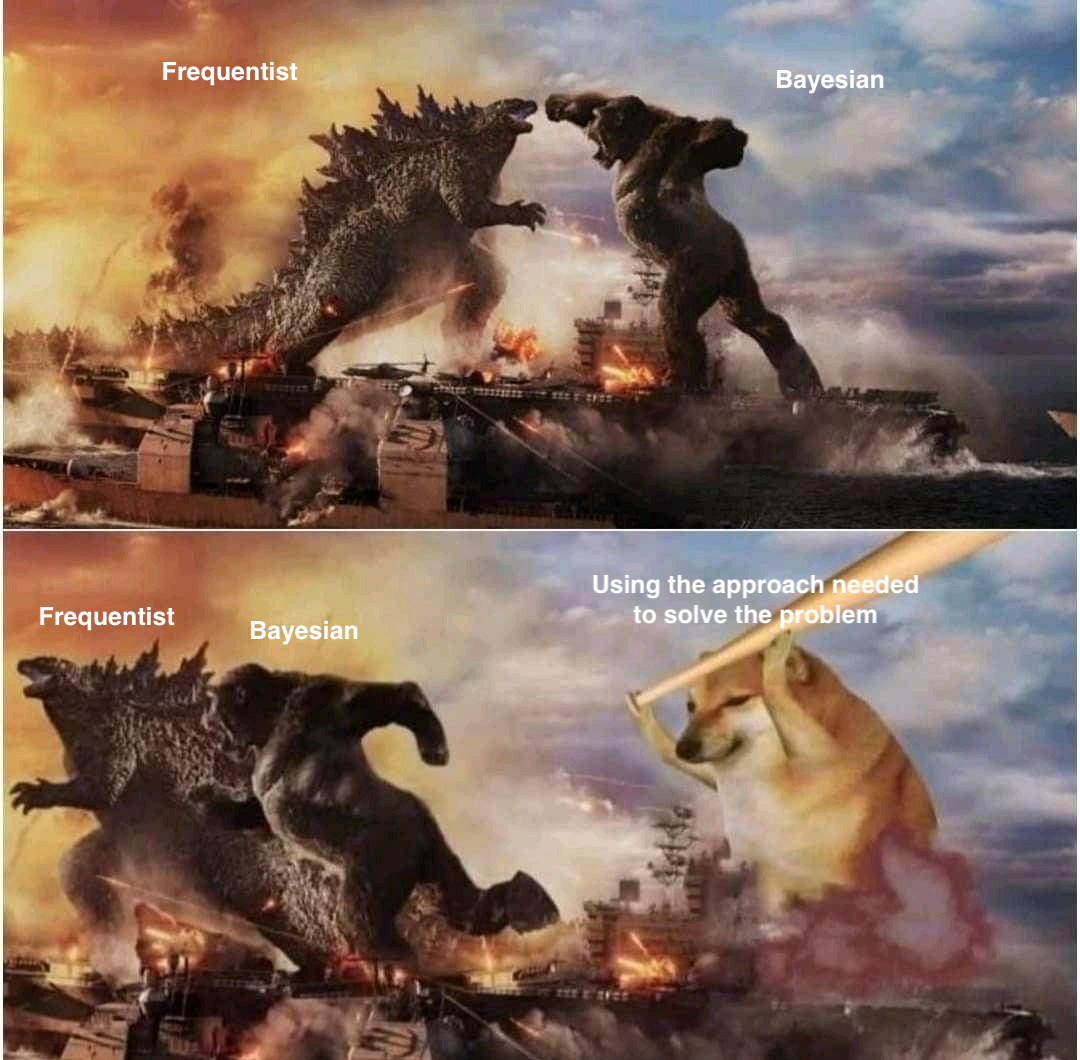
Is there a fight?
![]()
Is there a fight?
![]()
The Core Question
Why do we need a Bayesian approach to regression?
Can’t we just use ordinary least squares?
The answer is not (only):
- philosophy
- elegance
- a matter of preference
Real regression problems are often weakly identified, noisy, unstable, and geometrically pathological.
The ultra-quick answer
Bayesian regression stabilizes inference by:
- Explicitly stating expectations
- Constraining parameters, offering regularization
- Not using quardratic approximation of likelihood (for SD etc.)
When to use Frequentist and when to use Bayesian approaches?
Frequentist stats are often sufficient and comparable to Bayesian stats!
The data
Code
set.seed(18062026)

# Data
n <- 100                 # samples
x <- rnorm(n)            # x = N(0,1)
y <- 2 + 3*x + rnorm(n)  # α = 2, β = 3, ε = N(0,1)
The models
Frequentist:
Code
# Frequentist OLS
fit_freq <- lm(y ~ x)
Bayesian:
Code
# Bayesian regression with flat priors
library(rstanarm)
fit_bayes <- stan_glm(
  y ~ x,
  prior = NULL,            # flat prior on coefficients
  prior_intercept = NULL,
  chains = 2, iter = 2000, refresh = 0
)
What did we find?
Frequentist:
Code
parameters::parameters(fit_freq, ci = 0.95) |>
  dplyr::select(Parameter, Coefficient, CI, CI_low, CI_high)
# Fixed Effects

Parameter   | Coefficient |       95% CI
----------------------------------------
(Intercept) |        2.09 | [1.91, 2.28]
x           |        3.01 | [2.82, 3.20]
Bayesian:
Code
parameters::parameters(fit_bayes, ci = 0.95) |>
  dplyr::select(Parameter, Median, CI, CI_low, CI_high)
# Fixed Effects

Parameter   | Median |       95% CI
-----------------------------------
(Intercept) |   2.09 | [1.91, 2.27]
x           |   3.00 | [2.82, 3.20]
THEN WHY DO WE BOTHER!? 👀
When to use Frequentist and when to use Bayesian approaches?
A More Realistic example
Suppose we have:
- 30 observations
- 30 predictors
- strong predictor correlation
- weak signal
- uncertain mechanisms
This is extremely common in:
- social science
- biology
- psychology
- economics
- policy research
The Data Generating Process
The truth is simple.
Only one predictor matters.
\[
y = 2x_1 + \epsilon \\
\epsilon = Normal(0,2)
\]
All other predictors have zero effect.
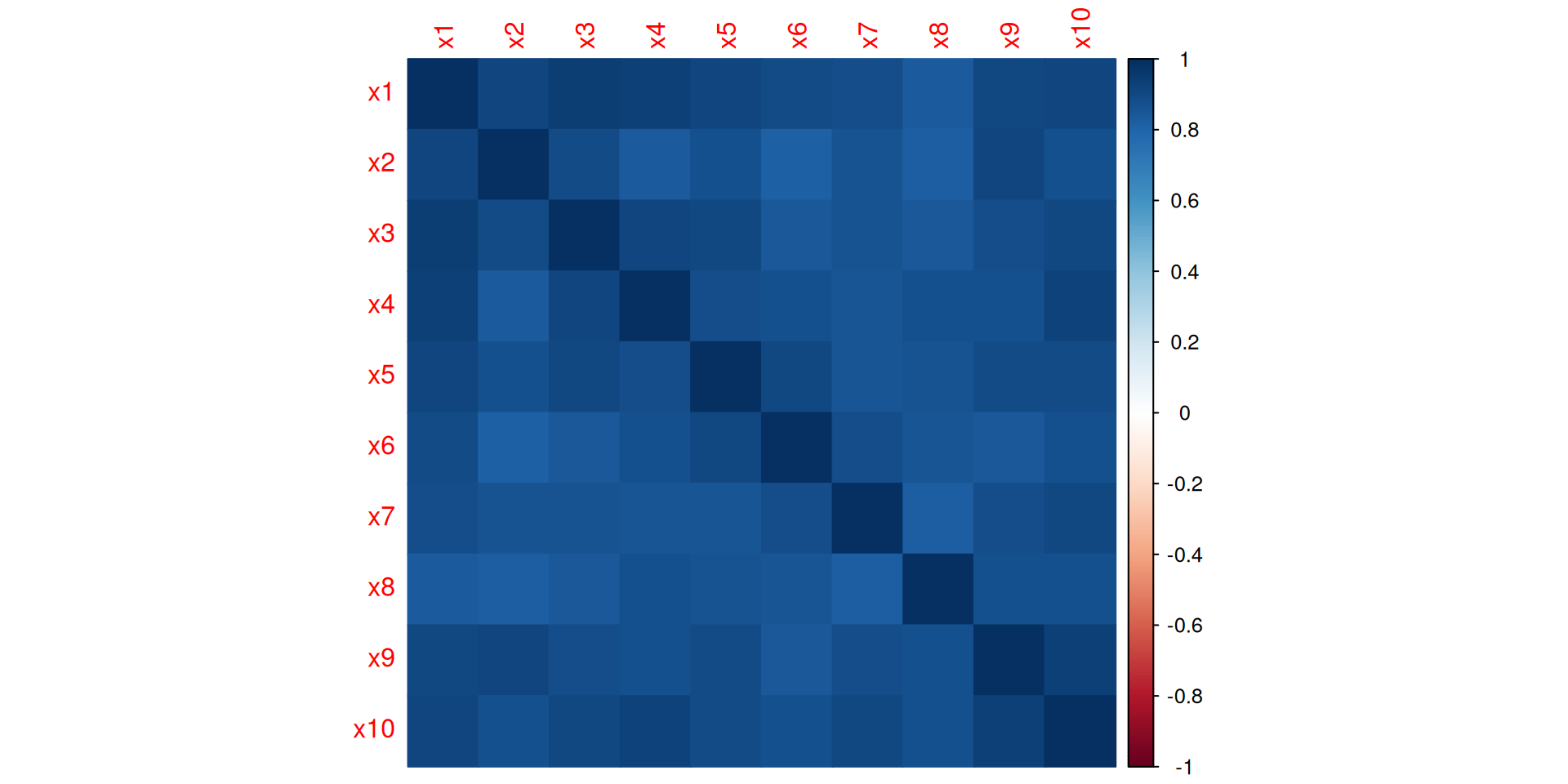
Yet predictors are highly correlated.
Talk to your neighbor
what do you think will happen?
- think about the model specification
- does the same happen in the Frequentist and Bayesian models?
- 30 observations (humans?)
- 30 predictors (genes?)
- strong predictor correlation (ρ ~ .8)
- weak signal (a.u. 2)
- noise at \(N(0,2)\)
- data generating process:
\[
y = 2x_1 + \epsilon \\
\epsilon = Normal(0,2)
\]
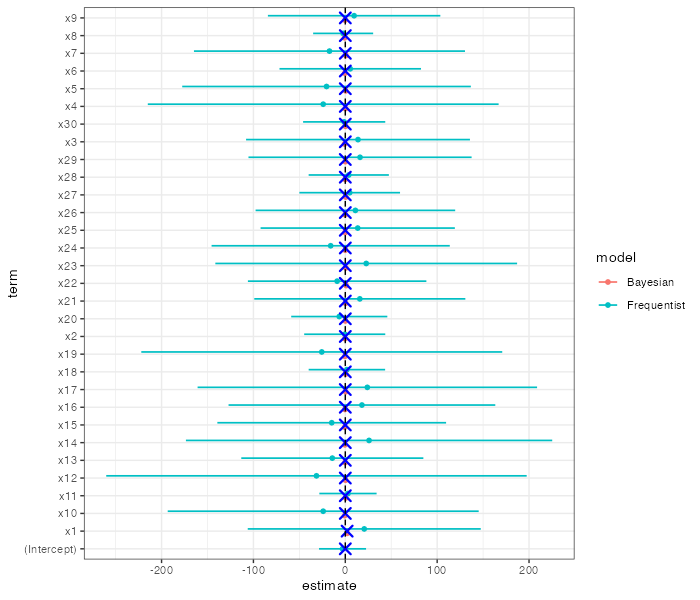
The model results when p=30 and n=30
![]()
What do you notice? 👀
x30 doesn’t even have an estimate due to unindentifiability!
Let’s try again - with more data!
what do you think will happen?
- 32 observations (humans?)
- 30 predictors (genes?)
- strong predictor correlation (ρ ~ .8)
- weak signal (a.u. 2)
- noise at \(N(0,2)\)
- data generating process:
\[
y = 2x_1 + \epsilon \\
\epsilon = Normal(0,2)
\]
The model results when p=30 and n=32
![]()
What do you notice? 👀
collinearity and inflates CIs and unstable coefficients!
The Mechanism of Failure
With correlated predictors:
- many coefficient combinations fit equally well
- the likelihood becomes nearly flat
- estimates dramatically change due to tiny noise
OLS asks:
Which coefficients minimize prediction error?
But it never asks:
Are these coefficient magnitudes plausible?
The Geometry Problem
Collinearity creates unstable directions in parameter space.
The matrix:
\[
(X^TX)^{-1}
\]
becomes nearly singular.
As a result:
- coefficients explode
- signs flip
- uncertainty becomes enormous
- interpretation collapses
The Bayesian Solution
Bayesian regression adds prior information:
\[
\beta_j \sim N(0,1.5) \\
\alpha \sim N(0,0.25) \\
\]
Posterior:
\[
p(\alpha, \beta \mid y,x)
\propto
p(y \mid x,\alpha, \beta)p(\alpha, \beta)
\]
The prior regularizes weakly identified directions.
This changes the geometry of inference.
![]()
Same thing here!
Important Clarification
Bayesian priors are not magic.
They encode structural skepticism.
The prior says:
Large coefficients should require strong evidence.
This is often scientifically reasonable.
Explaining the simulation Setup
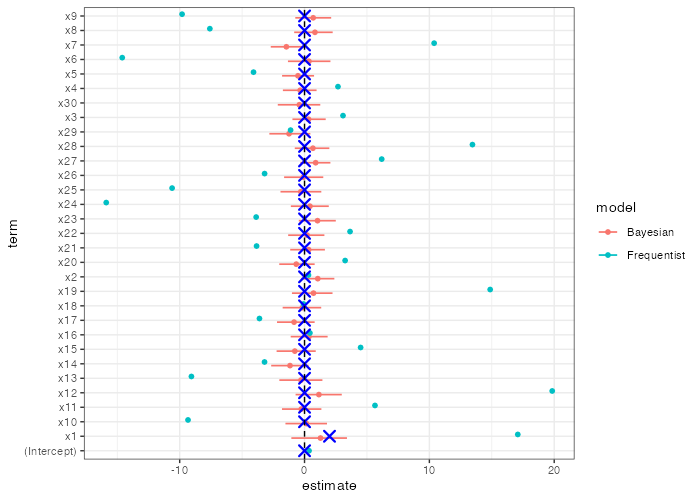
We simulated the failure directly:
- small sample
- many predictors
- high collinearity
- weak signal
Frequentist OLS
![]()
Why This Happens
Predictors are interchangeable.
The model can fit equally well using:
- huge positive x1
- huge negative x2
OLS has no mechanism preventing absurd parameter values.
It only optimizes fit.
The Frequentist Interpretation Problem
Researchers now face impossible interpretation.
Questions become unstable:
- Which variables matter?
- Which signs are trustworthy?
- Which effects are real?
p-values fluctuate wildly across samples.
Bayesian Regression
![]()
How did it do that?
Let’s have a look
![]()
Scientific sceptisism saves us from statistical model stupidity
What the Prior Does
The prior shrinks implausible coefficients toward zero.
Not aggressively.
Just enough to stabilize weakly identified directions.
This is called:
- regularization
- shrinkage
- partial pooling of uncertainty
Bias-Variance Tradeoff
Frequentist OLS emphasizes unbiasedness.
But unbiased estimators can have enormous variance.
Bayesian regression accepts:
- tiny bias
- dramatically lower variance
This often improves:
- prediction
- calibration
- scientific interpretation
In a nutshell…
OLS treats the model as fixed truth.
Bayesian workflow treats models as uncertain approximations.
This distinction is profound.
Posterior Interpretation
Frequentist confidence interval:
Does NOT mean: “There is a 95% probability the parameter lies here.”
Bayesian posterior interval:
Literally means: “Given model and data, there is 95% posterior probability the parameter lies here.”
Weak Identification
The Bayesian posterior honestly expresses:
- uncertainty
- partial identifiability
- lack of information
Sometimes the correct scientific answer is:
“We do not know very much.”
OLS often hides this instability behind noisy point estimates.
Posterior Predictive Thinking
Bayesian models naturally support:
- posterior predictive checks
- hierarchical models
- measurement error
- causal modeling
- uncertainty propagation
This enables model criticism rather than blind estimation.
Even More Extreme Failures…
Add complexity of:
- GLMs (often not multinomial Gaussian)
- Over-dispersion
- Outliers
OLS becomes nearly meaningless.
Coefficients:
- explode
- reverse sign
- inference just become sample-dependent noise
Meanwhile, Bayesian regularization still produces stable inference.
![]()
Final Thoughts
A prior is not some dangerous and mysterious trick that biases your model.
The Bayesian prior enforces that parameter values remain plausible after combining data with scientific structure
Cheers!
![]()
References
- Gelman, A., et al. Bayesian Data Analysis
- McElreath, R. Statistical Rethinking
- Vehtari, A., Gelman, A., Gabry, J. (2017) “Practical Bayesian model evaluation using leave-one-out cross-validation”
- Hastie, Tibshirani, Friedman. Elements of Statistical Learning